From a 19-year-old dropout to India's quick-commerce king. Read how Aadit Palicha built Zepto, redefined grocery delivery with the "Dark Store" model, and became a billionaire by 25.
 Rashmeet Kaur Chawla
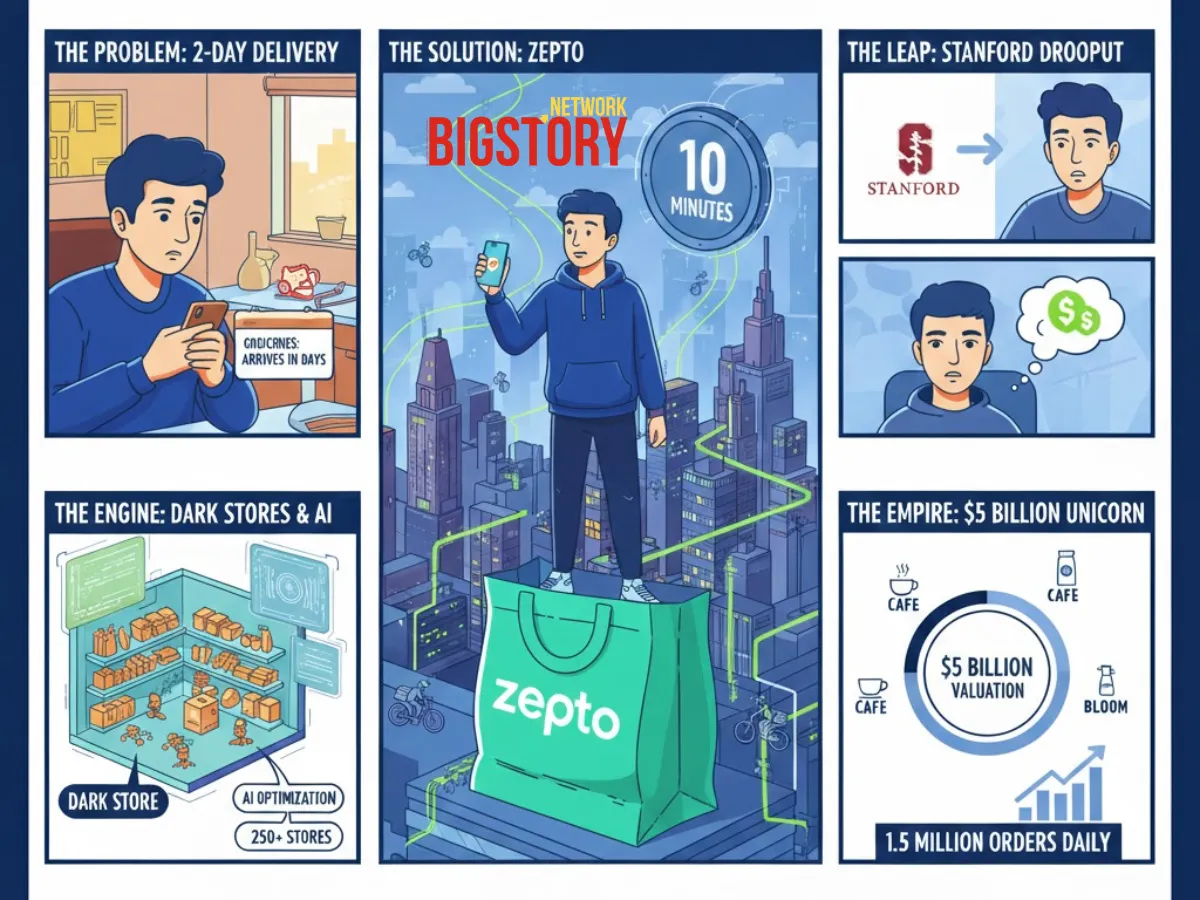
What does it take to build a $5 billion empire before turning 25?
For Aadit Palicha, co-founder and CEO of Zepto, the answer wasn't found in a Stanford degree or following conventional wisdom. It was discovered in the frustration of waiting for groceries during a pandemic lockdown—a problem that would spark one of India's fastest-growing startups and redefine an entire industry. This is the story of how a teenager from Dubai challenged India's slow delivery systems, dropped out of America's most prestigious university, and built a quick-commerce giant that delivers groceries in 10 minutes, fundamentally transforming how millions of Indians shop.
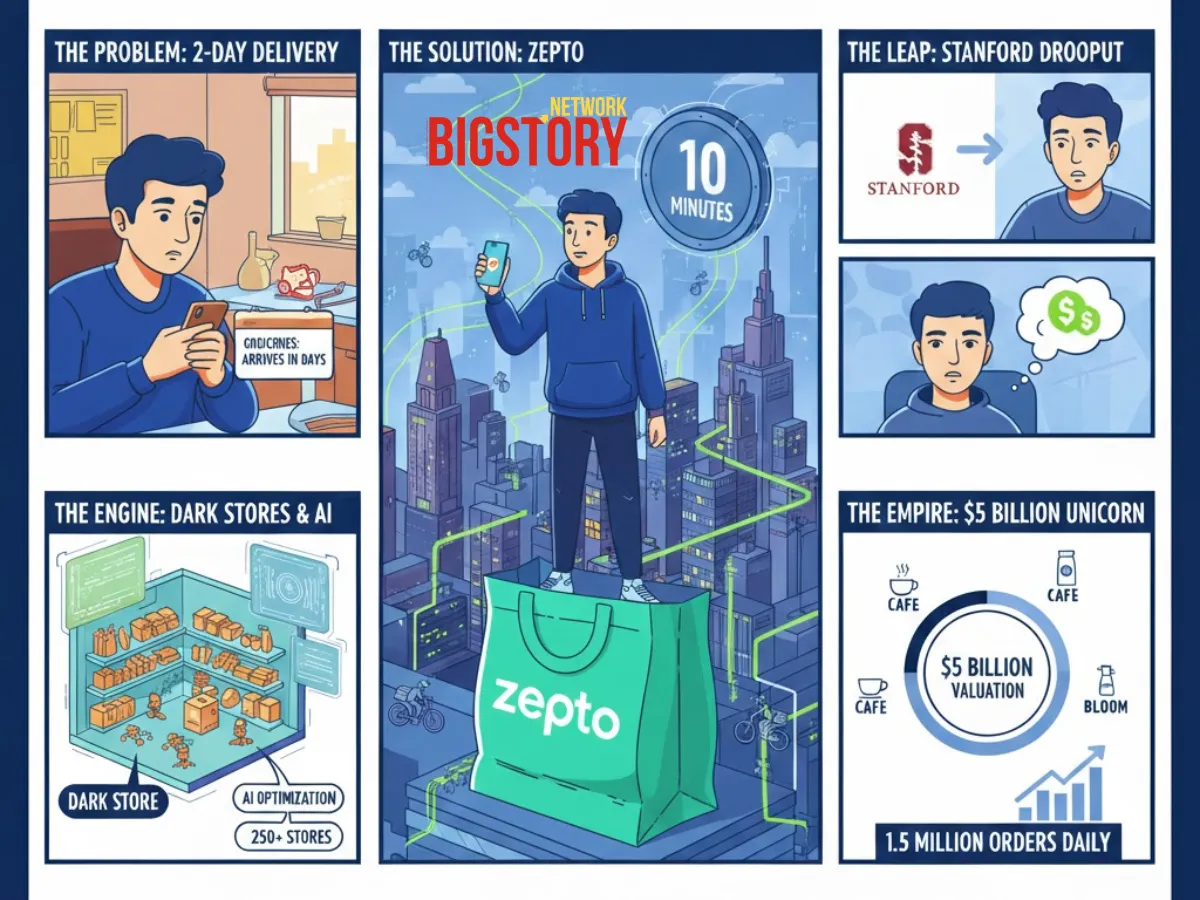
In 2020, when the world locked down, nineteen-year-old Aadit Palicha and his friend Kaivalya Vohra faced a problem that millions of Indians were experiencing: grocery delivery that took hours, sometimes days. Traditional e-commerce platforms were designed for convenience, not speed. Orders would arrive tomorrow, next week, whenever the logistics network could accommodate them. For young consumers accustomed to instant gratification in every other aspect of their digital lives, this lag was unacceptable.
But the conflict ran deeper than just slow delivery. India's retail infrastructure was fragmented, inefficient, and stuck in outdated models. Kiranas (neighbourhood stores) had the proximity but lacked technology. E-commerce giants had the technology but not the speed.
Aadit saw a massive gap: nobody was solving for real-time consumer needs.
While investors were skeptical about quick commerce's viability and profitability, and critics questioned whether speed was sustainable or just a gimmick, Aadit knew he had identified something fundamental — a pain point so acute that solving it could create an entirely new market category.
The personal conflict was equally intense. Born in Mumbai in 2001 but raised in Dubai at GEMS Modern Academy, Aadit came from a family of achievers. His father Kavit was an engineer, his mother Urvashi a recruiting CEO. They had supported his excellence — he scored a perfect 45 points in IB, topped Math and Computer Science courses, won multiple debate competitions, and earned admission to Stanford University for Computer Science.
For someone dropping out was not just risky — it defied everything his upbringing had taught him about success.
Aadit Palicha's fundamental belief can be distilled into one powerful conviction: action matters more than credentials. While the world worships degrees from prestigious institutions, Aadit recognized that solving real problems creates more value than collecting certificates. It was clarity born from observing what actually moved markets and changed lives.
"Speed is not a trend—it's addressing issues of real pain," Aadit has stated repeatedly. This philosophy guided every decision. When investors from Contrary Capital told him and Kaivalya to "quit Stanford, we'll fund you," they weren't being reckless. They recognized that the founders had identified a genuine market gap and possessed the execution capability to exploit it. Meanwhile, the pandemic had accelerated online adoption, but it had also exposed how woefully inadequate existing delivery infrastructure was for meeting urgent consumer needs.
This core belief extended to how Aadit approached failure and learning.
He didn't hide behind excuses or blame external factors. When Zepto made mistakes and there were many — Aadit owned them publicly. "Dark patterns? That was a mistake, we killed it," he said when criticized for aggressive user interface tactics. When questioned about the company's "10-minute delivery" branding potentially setting unrealistic expectations, he called it "a fair suggestion" rather than defending it defensively.
This intellectual honesty became a competitive advantage in an ecosystem where founders often deflect criticism.
Aadit's operational philosophy can be summarized as "build fast, fix faster." It's about recognizing that in fast-moving markets, speed of iteration beats perfection of planning. The traditional startup playbook says to validate, plan extensively, then execute carefully. Aadit flipped this: execute quickly, learn from real market feedback, and iterate ruthlessly.
This philosophy manifested in Zepto's product development. They didn't spend months building a perfect app before launch. They started with WhatsApp groups, testing demand manually before investing in technology infrastructure. This validated the core hypothesis—people desperately wanted faster delivery — before significant capital was deployed.
Once validated, they moved with exceptional speed, launching KiranaKart in 2020 and rebranding to Zepto in 2021, scaling to over 250 dark stores across 11+ cities within just a few years.
On team building, Aadit's philosophy is equally clear: He acknowledged hiring mistakes during Zepto's early hypergrowth, admitting the company built bloated teams during the funding boom of 2021-2022. But rather than letting underperformers drag down the organization, he implemented cost-cutting measures, eliminating entire layers of management that weren't adding value. His defense of high-performance culture drew criticism, particularly when anonymous Reddit posts alleged toxic work conditions including 2 AM meetings.
Most young founders cultivate carefully managed public personas, avoiding controversy and maintaining positive narratives. Aadit does the opposite. He engages directly with critics on platforms like Reddit and LinkedIn, addressing allegations head-on rather than through PR statements.
This approach extends to stakeholder management. In interviews, Aadit has stated, "We do not raise funds because people like my smile." This blunt assessment of investor relationships reflects his understanding that value creation, not charm, drives sustainable funding. He respects investors but doesn't defer to them on strategic decisions. When the market questioned quick commerce's unit economics, Aadit focused on improving operational efficiency rather than changing the business model to appease skeptics.
Aadit also demonstrates first-principles thinking in solving operational challenges. The dark store model—small, strategically located warehouses optimized for speed rather than breadth — wasn't invented by Zepto, but Aadit's team refined it for Indian market conditions. They used AI to optimize delivery routes, predict demand patterns, and manage inventory in real-time. This technological sophistication, applied to fundamentally local operations, created competitive advantages that were difficult to replicate.
The gap Aadit identified was elegantly simple but enormously consequential: consumers wanted their essential purchases delivered with the same speed as their digital content. You could stream a movie instantly, video call across continents in real-time, order food in 30 minutes—but getting basic groceries still required planning hours or days in advance.
Traditional grocery shopping involved trip planning, carrying heavy bags, navigating traffic, and spending significant time. Even existing e-commerce solutions required advance planning — you ordered today for tomorrow's delivery.
But consumer psychology had shifted. The smartphone generation expected immediacy. Aadit bet that if you could deliver groceries as fast as food delivery, you would create a new consumption pattern entirely.
The timing was perfect. The pandemic had forced digital adoption among demographics that previously resisted it. Older consumers, traditional shoppers, even skeptics were now comfortable ordering online. Simultaneously, venture capital was flooding into Indian startups. Labor costs remained relatively low, making asset-heavy models viable. And crucially, competitors were focused on building breadth (more products, more cities) rather than speed. Zepto's focus on 10-minute delivery in dense urban areas exploited all these conditions simultaneously.
The decision to drop out of Stanford became the defining moment that changed everything for Aadit.
By dropping out, Aadit burned his safety net. There was no fallback plan, no prestigious degree to fall back on if Zepto failed. This created what entrepreneurs call "founder commitment"—a state where success isn't just preferred, it's existentially necessary. This mindset permeated Zepto's culture. Employees weren't building a startup; they were joining a mission where failure was unacceptable.
The initial validation came quickly. Their WhatsApp-based tests showed overwhelming demand. Y Combinator, the world's most prestigious startup accelerator, accepted Zepto into their program, providing credibility and network access. The $730,000 pre-seed funding gave them runway to build infrastructure. But more importantly, it proved that serious investors believed in the vision. This external validation reinforced Aadit's conviction that he had made the right choice.
Aadit didn't just identify an opportunity—he executed relentlessly to dominate it. Zepto's dark store model required massive operational sophistication. Each location needed to stock thousands of SKUs, predict neighbourhood-level demand, and coordinate delivery logistics within minutes. This wasn't software innovation alone; it was combining technology with on-ground operations at unprecedented speed and scale.
The company introduced innovations like Cafe and Bloom—specialized offerings targeting specific consumer segments. Cafe focused on ready-to-eat meals and beverages, competing directly with food delivery apps. Bloom catered to beauty and personal care, a high-margin category with strong repeat purchase behaviour. These extensions demonstrated Aadit's understanding that quick commerce wasn't limited to groceries—it was a logistics platform that could deliver anything consumers needed urgently.
By leveraging AI for route optimization and demand forecasting, Zepto achieved delivery efficiency that competitors struggled to match. The company handled 1.5 million orders daily across 250+ dark stores, a scale that required extraordinary technological and operational coordination. This execution capability became Zepto's moat—competitors could copy the concept, but replicating the operational excellence required years of iteration and learning.
Despite rapid growth, Aadit faced brutal challenges that tested his resolve. The funding winter of 2022-2023 hit Indian startups hard. Capital that had been freely available suddenly evaporated. Startups that had grown recklessly faced existential crises. Zepto, having hired aggressively during the boom, found itself with bloated teams and unsustainable burn rates.
The company had to prove it could reach profitability without endless funding. This period tested not just financial management but leadership character. Firing people, especially in a company you've built from scratch, is emotionally taxing. But Aadit prioritized organizational survival over individual comfort.
The collapse of Silicon Valley Bank added another layer of uncertainty. Many startups had deposits frozen, creating liquidity crises. Zepto had to navigate this turbulence while maintaining operations and employee confidence. Aadit's transparent communication during this period—explaining the challenges without sugarcoating them—built trust with stakeholders even during the crisis.
Public criticism also intensified. Anonymous Reddit posts alleged toxic work culture, with claims of 2 AM meetings and unreasonable expectations. Critics accused Zepto of using "dark patterns"—manipulative UI designs that trick users into unintended actions.
Competition from well-funded rivals like Blinkit (acquired by Zomato) and Swiggy Instamart created constant pressure. These competitors had deeper pockets, established brand recognition, and existing customer bases. Zepto had to outexecute them consistently to maintain market share. Every operational mistake, every service failure gave competitors an opening.
Today, Zepto stands as one of India's fastest-growing startups and a testament to Aadit's vision. With a $5 billion valuation achieved by 2024 and total funding of $1.95 billion, the company has reached rarified air. Aadit's personal net worth is estimated at approximately ₹4,300 crore, making him one of the youngest self-made billionaires in India and earning him a spot on Forbes 30 Under 30 Asia.
The operational metrics are equally impressive. Operating in 11+ cities with over 250 dark stores, Zepto processes 1.5 million orders daily. This scale was achieved in under four years—a growth trajectory that rivals even India's most successful startups. The company has moved beyond pure grocery delivery into categories like prepared food (Cafe) and beauty products (Bloom), demonstrating platform versatility.
More importantly, Zepto has fundamentally altered consumer behavior in Indian urban markets. The concept of 10-minute delivery, once considered impossible or unsustainable, is now expected by millions of consumers. Traditional retailers and e-commerce platforms have been forced to adapt, introducing their own quick-commerce offerings. Aadit didn't just build a company — he created a market category.
Why Aadit Palicha Embodies the Challenger Spirit: The Manifesto
Aadit Palicha is a challenger in the truest sense — someone who questions established norms and rebuilds systems from first principles. His journey challenges multiple orthodoxies:
The Credential Myth: Society worships prestigious degrees. Aadit proved that solving real problems matters more than collecting certificates. His Stanford dropout story isn't about rejecting education — it's about recognizing when opportunity costs exceed credential value.
The Safety-First Mentality: Most people choose safe paths—stable careers, predictable trajectories, risk mitigation. Aadit chose speed over safety, betting everything on an unproven model. His willingness to fail publicly separated him from cautious competitors.
The Slow-and-Steady Approach: Traditional wisdom says build carefully, scale gradually, perfect before launching. Aadit demonstrated that in fast-moving markets, speed of iteration beats perfection of planning. This challenger mentality—move fast, learn quickly, adapt ruthlessly—proved superior.
The Work-Life Balance Narrative: Modern startup culture often emphasizes work-life balance. Aadit challenged this by openly defending high-performance cultures that demand intensity. His honesty—"high-performance creates winners"—was refreshing even when controversial.
The Incumbent Advantage: Established players like Amazon, Flipkart, and traditional retailers dominated Indian commerce. Aadit proved that focusing on one dimension—speed—and executing flawlessly could create competitive advantages that incumbents couldn't replicate despite superior resources.
A thoughtful reflection on how meaningful change can be created by this BIGSTORY?
Aadit Palicha’s journey from a Stanford student to the co-founder of Zepto offers more than a startup success story—it presents a thoughtful reflection on how meaningful change is created. His path highlights that vision is often discovered through awareness rather than formal instruction.
Instead of waiting for perfect readiness or external approval, Aadit acted on a problem many had noticed but few attempted to solve. His approach reminds us that real learning often happens through execution, and that progress is shaped not only by credentials, but by the willingness to take responsibility and act with intent.
Central to Aadit’s philosophy is the belief that speed, honesty, and customer understanding are essential to building lasting systems. Zepto’s growth was driven by quick iteration, openness about challenges, and a consistent focus on genuine customer needs. By acknowledging mistakes and improving transparently, trust was strengthened rather than diminished. Equally important was maintaining high standards—building a focused team aligned with shared expectations, and adapting global insights thoughtfully to local realities.
Aadit Palicha transformed a simple frustration with grocery delivery into a $5 billion enterprise by identifying a broken system and moving faster than convention allowed. His journey illustrates how meaningful change often begins by challenging accepted norms and rethinking what is considered “safe.” The resources, technology, and capital to build at scale already exist; what differentiates challengers is the willingness to trade comfort for velocity and conviction.
This story about the mindset required to disrupt entrenched systems. Progress belongs to those who are prepared to step beyond familiar paths, question inherited wisdom, and act decisively when opportunity appears. In that leap—from caution to courage—challengers are made.
Who is Aadit Palicha?
Aadit Palicha is the co-founder and CEO of Zepto. Born in Mumbai and raised in Dubai, he dropped out of Stanford University's Computer Science program at age 19 to launch Zepto, becoming one of India's youngest billionaires with a net worth of approximately ₹4,300 crore.
What is Zepto's business model?
Zepto operates on a "Quick Commerce" model using a network of over 250 "dark stores" (micro-warehouses). These stores are strategically located in dense urban areas and use AI-driven inventory management to deliver groceries and essentials in 10 minutes.
Why did Aadit Palicha drop out of Stanford?
Aadit dropped out of Stanford because he saw a "once-in-a-generation" opportunity to disrupt India's grocery market during the pandemic. He believed that solving a real-world pain point (slow delivery) created more value than a prestigious degree.
What is Zepto's valuation?
As of 2024, Zepto has achieved a valuation of $5 billion, attaining "Unicorn" status. The company has raised over $1.95 billion in funding from investors like Y Combinator, Nexus Venture Partners, and others.
What are Zepto Cafe and Bloom?
Zepto Cafe and Bloom are specialized verticals within the Zepto app. Cafe focuses on delivering ready-to-eat snacks and beverages (competing with food delivery apps), while Bloom focuses on beauty and personal care products to capture higher-margin sales.
 Exclusive Content



Sign up for the Daily newsletter to get your biggest stories, handpicked for you each day.



 Trending Now! in last 24hrs